
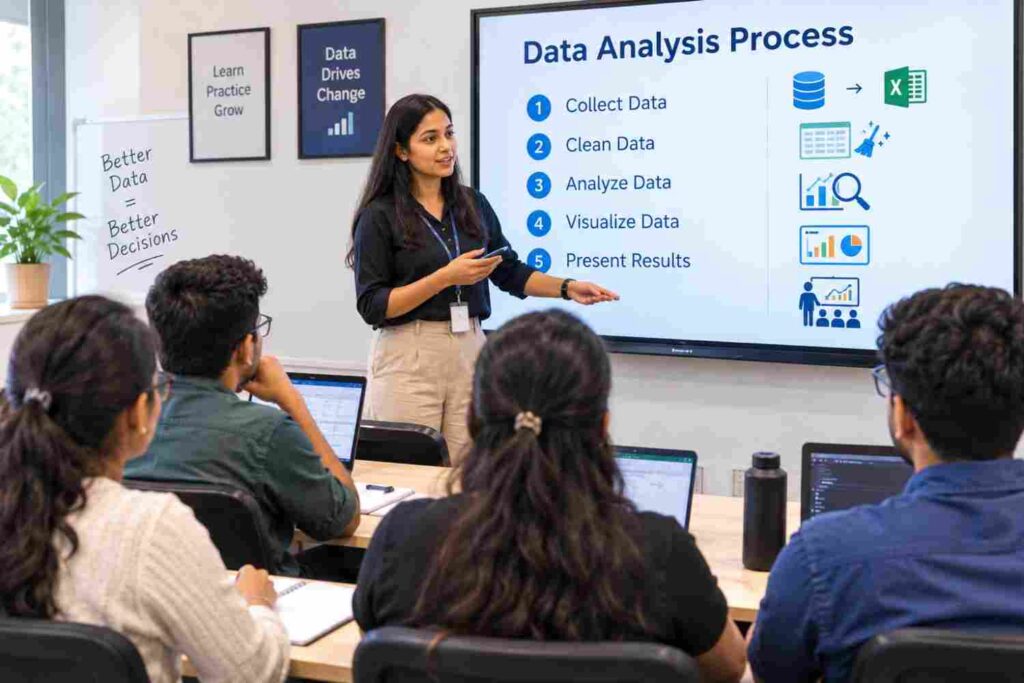
Data Analyst Course in Vadodara: 7 Things to Check Before Enrolling
Every month, a lot of students and working professionals in Vadodara search for a data analyst course. Some are final-year graduates who want a clear career path. Others are working in accounts, operations or sales and are tired of making decisions without data. The interest is real, and so is the confusion.
Open any search page and you will find dozens of options. Each one promises “100% practical training” and “job-ready skills”. The brochures look almost the same, but the learning experience is not. Some institutes teach tools without teaching thinking. Some show you finished dashboards without letting you build one. Choosing the wrong course costs you months of effort and a good amount of money.
This guide gives you seven practical checks to run before you enrol in any Data Analyst course in Vadodara. Use it as a checklist when you visit an institute, talk to a counsellor or sit through a demo class.
What Does a Data Analyst Actually Do?
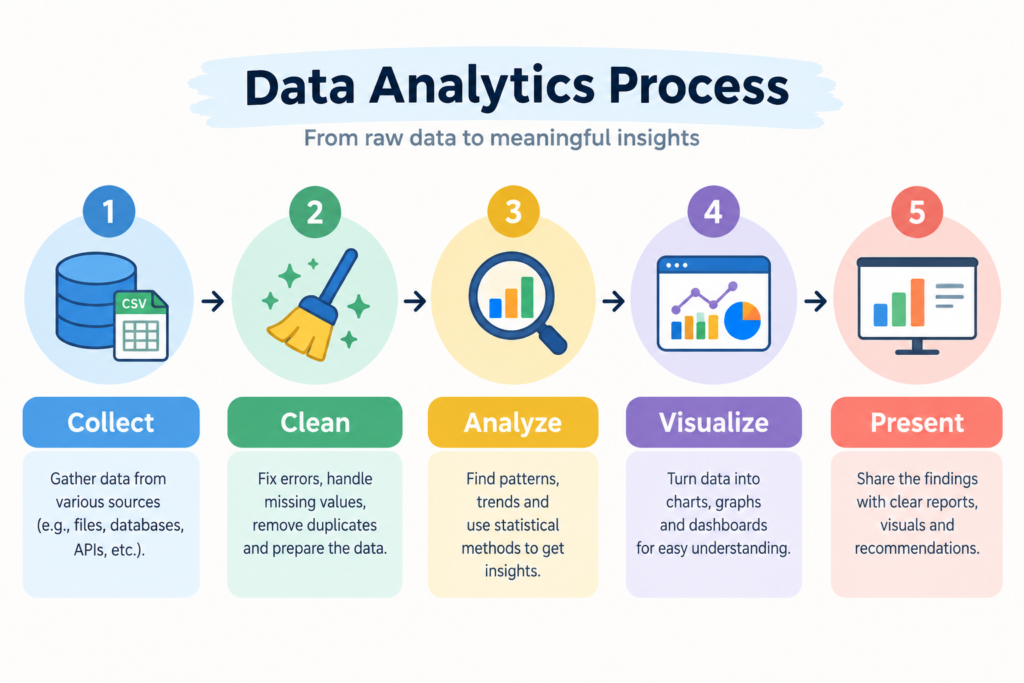
It helps to be clear about the job first, because it tells you what a good course must teach.
A data analyst takes raw, messy information and turns it into answers a business can act on. A retail store owner might want to know which products sell slowly in monsoon. A college might want to understand why admissions dropped in one batch. A manufacturing unit might want to track which machine causes the most delays. The analyst collects the data, cleans it, studies it, and presents the findings in a form that decision-makers can use.
A typical week involves a few repeating tasks:
- Pulling data from spreadsheets and databases
- Cleaning errors, duplicates and missing values
- Finding patterns with statistics
- Building charts and dashboards
- Explaining the findings to people who are not technical
Notice that only some of these tasks are about software. The rest are about thinking and communication. A course that ignores that will leave you with certificates but not skills.
Why Vadodara Is a Good Place to Start
Vadodara has a mixed economy. The city and the industrial belt around it include manufacturing, engineering, pharmaceuticals, chemicals, education, banking and a growing services sector. Almost all of these businesses generate data about sales, inventory, production, customers or finances, and many of them are still learning to use it well.
That means a trained analyst can find work in more than one type of company, not only in IT firms. It also means you can often learn in your own city without relocating to a bigger metro. If you are a student from areas such as Manjalpur, Sayajigunj, Alkapuri, Waghodia, Gotri, Akota or Karelibaug, an institute within reach saves you hours of travel every week, which matters when you are studying alongside college or a job.
That said, the best institute for you is the one that teaches well, not the one that is closest. Here is how to judge that.
1. Check the Syllabus for Depth, Not Just Tool Names
The first thing most institutes show you is a long list of tools. A syllabus that simply says “Excel, SQL, Python, Power BI” tells you very little. What matters is how much of each tool is covered and in what order.
A complete data analyst syllabus should cover these areas:
| Module | What it should teach you |
|---|---|
| Advanced Excel | Formulas, lookups, pivot tables, data validation, basic dashboards |
| SQL | Writing queries, joins, filtering, grouping, subqueries |
| Statistics | Averages, spread, probability basics, correlation, simple testing |
| Python | Basic programming, working with data tables, cleaning data |
| Data Cleaning and EDA | Handling missing values, outliers, and exploring data to find patterns |
| Power BI | Connecting data, building reports, interactive dashboards |
| Data Visualization | Choosing the right chart and telling a story with it |
| Real-world Projects | Working on complete business problems from start to finish |
| Interview and Portfolio Preparation | Resume, project presentation, mock interviews |
Bright Computer Education structures its Data Analyst Training in Vadodara around these nine areas, moving from Excel and SQL through statistics and Python to Power BI and projects. When you compare institutes, check whether the order makes sense. A course that jumps to Python before you understand data basics will lose most beginners.
Quick test: Ask the counsellor, “How many hours are given to SQL, and what will I be able to do after that module?” A confident answer with specifics is a good sign. A vague answer is a warning.
2. Confirm the Course Matches Your Starting Point
Not every student walks in with the same background. Some have never opened a spreadsheet seriously. Others already know basic Excel and want to move into analytics.
Ask these questions:
- Is there a Data Analyst course for freshers, or does it assume prior knowledge?
- Do I need a programming background or a particular degree?
- What happens if I fall behind in a class?
Graduates from commerce, science, engineering, BCA, BBA and other streams can all learn data analysis. You do not need to be a mathematics topper. You do need patience with numbers and curiosity about why things happen.
A good institute will set expectations honestly. If a counsellor says “anyone can become a data analyst in 30 days,” be careful. Real skill takes consistent practice over a few months.
Also note the difference between data analyst and data analytics in course names. Many institutes use the two terms interchangeably, which is fine, but make sure the content is about the analyst role: cleaning, querying, visualizing and reporting. If a course is really about machine learning or data science, it will be heavier on mathematics and programming, and it may not suit a beginner who wants an analyst job.
3. Look for Real Projects, Not Only Practice Exercises
This is the check that separates useful courses from decorative ones.
Practice exercises are small tasks, such as “write a query to find the top five customers.” They are necessary, but they do not prepare you for real work. Real work is messy. The data has gaps. The question is unclear. The manager wants the answer by evening.
A good course includes projects that mirror this. Examples of what a solid project looks like:
- Sales analysis: Take a year of store sales data, clean it, and find which products and months drive revenue. Present it in a Power BI dashboard.
- Customer behaviour study: Segment customers by purchase pattern and suggest what the business should do with each group.
- HR or admissions report: Analyze student or employee records to track trends over time.
- Inventory tracking: Spot slow-moving stock and suggest reorder levels.
Ask the institute: “Will I build projects myself, or will I watch the trainer build them?” The difference is large. You learn by doing, struggling and fixing.
Also ask whether you will get to keep your projects. These become your portfolio, and a recruiter will trust a portfolio far more than a certificate.
3. Look for Real Projects, Not Only Practice Exercises
This is the check that separates useful courses from decorative ones.
Practice exercises are small tasks, such as “write a query to find the top five customers.” They are necessary, but they do not prepare you for real work. Real work is messy. The data has gaps. The question is unclear. The manager wants the answer by evening.
A good course includes projects that mirror this. Examples of what a solid project looks like:
- Sales analysis: Take a year of store sales data, clean it, and find which products and months drive revenue. Present it in a Power BI dashboard.
- Customer behaviour study: Segment customers by purchase pattern and suggest what the business should do with each group.
- HR or admissions report: Analyze student or employee records to track trends over time.
- Inventory tracking: Spot slow-moving stock and suggest reorder levels.
Ask the institute: “Will I build projects myself, or will I watch the trainer build them?” The difference is large. You learn by doing, struggling and fixing.
Also ask whether you will get to keep your projects. These become your portfolio, and a recruiter will trust a portfolio far more than a certificate.
4. Meet the Trainer and Sit Through a Demo Class
The trainer shapes your experience more than the brochure does. A good trainer explains why a method works, not only which button to click.
Before you pay anything, ask for a demo session. While you are there, watch for these things:
- Clarity. Can you follow the explanation even if the topic is new?
- Industry exposure. Does the trainer give examples from actual business situations?
- Patience with questions. Are doubts welcomed or brushed aside?
- Hands-on pace. Do students type and try along, or only listen?
It is also fair to ask about the trainer’s own background. How long have they worked with data? Have they handled real projects? You are not demanding a biography, just checking that the person teaching you has actually done the work.
Batch size matters too. In a very large batch, a beginner can easily get lost. Ask how many students sit together and whether there is time for one-on-one doubt solving.
5. Ask About Tools, Software and Lab Access
Data analysis is learned on a computer, so the practical setup counts.
Find out:
- Are the tools used in class the same ones used in industry (Excel, MySQL or SQL Server, Python, Power BI)?
- Do I get lab time to practise outside class hours?
- Are the software versions recent?
- Can I install the free versions on my own laptop to practise at home?
Many of the tools you need are free or have free versions. You should not be told to buy expensive software just to complete the course. If the institute asks for extra charges for tools, get it in writing before you enrol.
A practical tip: choose an institute that encourages you to practise at home. Students who spend even an hour a day on their own progress much faster than those who only attend class.
6. Understand What Placement Support Really Means
Placement is the most misunderstood part of any computer course. The honest truth is that no institute can promise you a job. Hiring depends on your skills, your communication and the market. What a good institute can do is prepare you properly and connect you with opportunities.
When someone says “placement support,” ask exactly what it includes:
- Resume building and LinkedIn profile guidance
- Mock interviews with feedback
- Portfolio review
- Interview question practice for SQL, Excel and case-style questions
- Information about openings and referrals
Be cautious about guarantees such as “100% placement” or promised salary figures. A trustworthy institute will talk about preparation and effort rather than making promises it cannot keep.
Ask to speak with former students if possible. Where are they working now? Did the training help them in interviews? Their answers will tell you more than any advertisement.
7. Compare Fees, Duration and Flexibility Fairly
Cost matters, but the cheapest course is rarely the best value, and the most expensive one is not always better.
When comparing fees, look at the whole picture:
| Factor | Question to ask |
|---|---|
| Total fee | Is everything included, or are there extra charges? |
| Duration | How many months, and how many hours per week? |
| Class timing | Are there weekday, weekend or evening batches? |
| Missed classes | Can I attend a missed session in another batch? |
| Certification | Is the certificate from the institute, and what does it cover? |
| Payment | Is instalment payment available? |
Duration deserves special attention. A course that finishes too quickly cannot cover nine modules and projects in any real depth. A course that drags on for too long may waste your time. Ask for a week-by-week plan so you can see how the hours are used.
If you are working, flexible batches are important. A course you cannot attend regularly will not help you, however good it is on paper.
A Simple Way to Compare Two Institutes
When you have shortlisted two or three options, score each on a scale of 1 to 5 across the seven checks above. Write it down rather than trusting your memory.
- Syllabus depth
- Fit for your background
- Real projects
- Trainer and demo class
- Tools and lab access
- Placement preparation
- Fees and flexibility
Add up the scores. The institute with the higher total is usually the better choice, but also trust your gut feeling after the demo class. If you felt confused or rushed, take that seriously.
Common Mistakes Students Make
Learning from other people’s mistakes can save you time. These are the ones we see most often:
- Choosing by price alone. A low fee is no bargain if you finish without usable skills.
- Skipping the demo class. Brochures cannot show you the teaching style.
- Collecting certificates instead of skills. Employers test what you can do.
- Ignoring SQL. Many beginners rush to Python, but SQL is used in nearly every analyst role.
- Not practising after class. Skills fade quickly without repetition.
- Expecting a job immediately. Plan for a few months of applications and interviews after the course.
How to Make the Most of Your Course
Once you pick a course, your own effort decides the result. A few habits help a lot:
- Practise daily, even for 45 minutes.
- Work with real datasets, such as public data on government portals, instead of only the sample files.
- Explain your project to a friend or family member. If they understand it, your communication is working.
- Build two or three strong projects instead of ten weak ones.
- Update your LinkedIn profile as you learn.
- Ask questions in class without hesitation.
Frequently Asked Questions
Check the course syllabus, practical projects, tools covered, trainer experience, certification, placement assistance, course duration, and student reviews before enrolling.
A good course should cover essential tools such as Excel, SQL, Power BI, Tableau, and Python, along with data cleaning, visualization, and reporting.
Yes. Many successful analysts come from commerce, arts and science backgrounds. Starting with Excel and SQL, which are beginner-friendly, makes the transition easier.
Not at the very start. Excel, SQL and Power BI cover a lot of entry-level work. Python becomes useful as you grow, so a good course introduces it gradually.
Yes. Beginners can start with basic Excel and gradually learn SQL, data visualization, statistics, and other analytics tools through practical training.
It depends on the course and your practice time. Most structured programmes run for a few months, and you should expect to keep learning on the job afterwards.
An analyst focuses on cleaning, querying, reporting and visualizing existing data. A data scientist works more with advanced statistics, machine learning and prediction. Many people start as analysts and move on later.
Offline classes give you direct interaction and lab access, which many beginners find easier. Online suits those with tight schedules. Whichever you choose, make sure there is hands-on practice.
At minimum: Excel, SQL, a visualization tool such as Power BI, and basic Python. Statistics and project work should be part of it.
Attend a demo class, speak with current or past students, ask for a clear syllabus and fee structure in writing, and be wary of unrealistic guarantees.
No. A certificate shows you attended. Your projects, problem-solving and communication in interviews decide the outcome.
Final Thoughts
A good Data Analyst course in Vadodara should teach you to think with data, not only to operate software. Check the syllabus depth, confirm that the course suits your starting point, look for real projects, meet the trainer, ask about tools, understand what placement support truly means, and compare fees fairly.
If you would like to see how a structured programme works in practice, you can visit Bright Computer Education, one of the options for computer courses in Vadodara, and attend a demo session before deciding. Whichever institute you choose, take your time, ask direct questions and trust what you observe rather than what you are promised.