
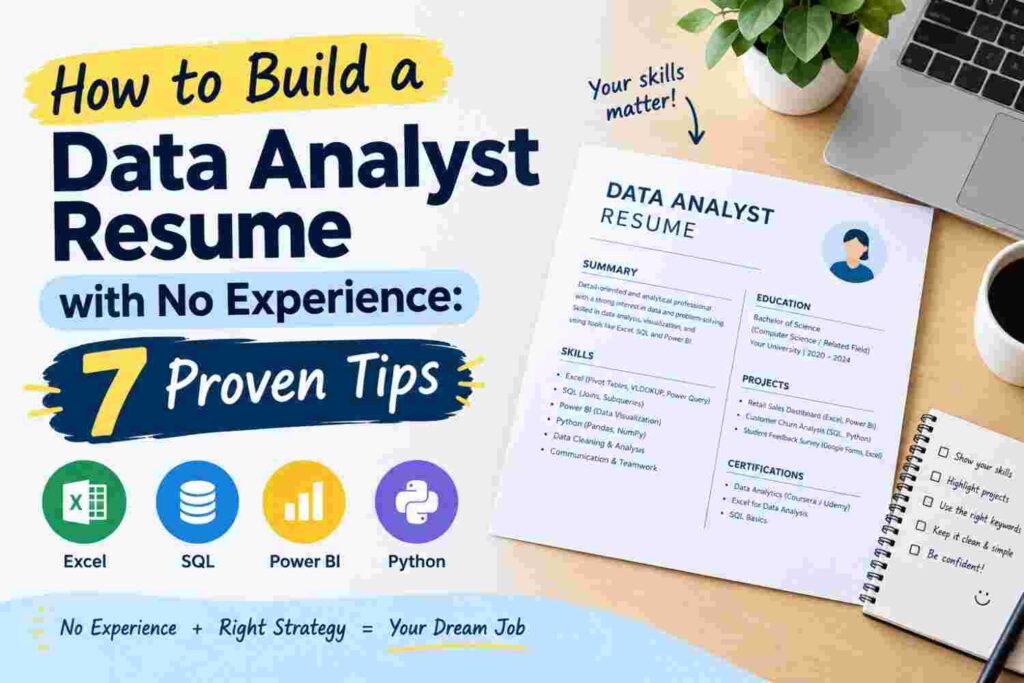
How to Build a Data Analyst Resume with No Experience: 7 Proven Tips
You can build a strong data analyst resume with no experience by showing proof of skill instead of years on the job: a focused summary, a clear skills section, two or three real projects, and results you can measure.
Every year, thousands of graduates and career switchers in Gujarat open a blank resume file and freeze at the same line: “Work Experience.” If you have never held the title of data analyst, that section feels empty. The good news is that hiring managers know freshers have no job history. What they actually check is whether you can work with data, explain what you found, and learn quickly.
The demand side of the story is encouraging. Companies in Vadodara, Ahmedabad and Surat, from manufacturing and pharma to IT services, logistics and retail, collect more data every year and need people who can turn spreadsheets and databases into decisions. Many students who join computer courses in Vadodara have this career in mind, and a well-built resume is the first step from classroom to interview.
This guide walks you through seven practical tips, a sample resume layout, common mistakes, and answers to the questions freshers ask most. Everything here is written for beginners, so you can follow it step by step even if you have never written a professional resume before.
What Recruiters Look for in a Fresher Data Analyst Resume
Recruiters usually spend less than a minute on a first scan, so your resume must answer four questions quickly:
- Can this person work with data? Tools such as Excel, SQL, Power BI, Tableau or Python should be visible near the top.
- Have they done real work? Projects with a clear problem, dataset, method and result prove this.
- Can they communicate? A short, clean resume with plain sentences signals that you can also write clear reports.
- Will they grow? Courses, certifications and regular practice show that you keep learning.
Notice that none of these questions asks for a previous job. That is why a data analyst resume with no experience can still compete, as long as every section is built around evidence. The seven tips below show how to create that evidence and present it well.
Tip 1: Start with a Sharp Summary and a Clean Format
Your summary is the first thing a recruiter reads, so write it for the job, not for yourself. Replace vague lines such as “hardworking fresher seeking a challenging role” with a specific statement of what you can do.
Weak example: “Fresher looking for an opportunity to grow in a reputed company.”
Stronger example: “Data analyst trainee skilled in SQL, Excel and Power BI. Built three projects on sales, HR and customer data, including a dashboard that tracked monthly revenue by region. Looking for an entry-level analyst role.”
Keep the format simple. Use one page, a standard font such as Calibri or Arial at 10 to 11 points, clear section headings and consistent spacing. Avoid photos, graphics, skill bars and multiple columns, because these confuse the Applicant Tracking Systems (ATS) that many companies use to filter resumes.
Tip 2: Lead with a Skills Section Recruiters Can Scan
Without job history, your skills section becomes the backbone of the resume. Place it directly under the summary and group skills so the reader can scan them in seconds.
| Skill Group | Examples to Include |
|---|---|
| Data Handling | Excel (Pivot Tables, VLOOKUP/XLOOKUP, Power Query), Google Sheets |
| Databases | SQL (Joins, Subqueries, Window Functions), MySQL, PostgreSQL |
| Visualization | Power BI, Tableau, Excel Charts |
| Programming | Python (Pandas, NumPy, Matplotlib) |
| Statistics | Descriptive Statistics, Correlation, Basic Hypothesis Testing |
| Soft Skills | Data Storytelling, Report Writing, Attention to Detail |
Only list tools you can actually discuss in an interview. If you write “Python” and cannot explain how you cleaned a dataset with Pandas, the interviewer will notice within minutes. It is better to list five tools you know well than fifteen you have only watched videos about.
Tip 3: Build Two or Three Real Projects
Projects are the single most powerful substitute for experience. A recruiter who sees a project that mirrors a real business problem will treat you as someone who has already started the job.
Good beginner project ideas include:
- Sales analysis: Clean a retail sales dataset, find the top products and weak months, and build a Power BI dashboard.
- Customer churn: Use SQL and Python to find which customer groups leave most often and suggest one retention idea.
- HR attrition study: Analyse employee data to show how salary, tenure and department relate to resignations.
- Local business case: Study public data on local shops, schools or transport and answer one practical question for your city.
For each project, write three to four short lines: the problem, the data source, the tools you used, and what you discovered. Publish the work on GitHub, Kaggle or a simple portfolio page and add the link to your resume. Choose datasets from public sources and credit them properly, and never copy another person’s notebook. Original work, even if it is small, is worth far more than a polished project you cannot explain.
Tip 4: Show Structured Training and Certifications
A structured course tells a recruiter that your skills were built in an organised way and tested by trainers. If you have trained at an institute, list the course name, the institute, the duration and the tools covered. For example, a student who completes a data analytics programme at a Vadodara institute such as Bright Computer Education can write the course title, the months of training and the practical modules, such as Excel, SQL and Power BI, in a single clear line.
Certifications add extra weight when they match the job. Useful options for beginners include Microsoft’s Power BI Data Analyst Associate, Google’s Data Analytics Professional Certificate, and vendor-neutral SQL or Python certificates. Add only the ones you have really completed, and put the most relevant first.
The education section should be short for a fresher: degree, college, university and year. If your final-year project or a subject such as statistics or database management is related to analytics, mention it in one line.
Tip 5: Turn Internships, Practice Work and Volunteering into Experience
“No experience” rarely means “no work at all.” Think about everything you have done that involved numbers, reports or decisions, and present it as experience.
- Internships and trainee roles: Even a two-month internship counts. Describe the data you handled and the output you produced.
- Freelance or practice tasks: Cleaning a friend’s shop records in Excel or building a sales tracker for a family business is genuine work.
- College or club activities: Managing event budgets, running surveys or analysing feedback forms shows analytical thinking.
- Virtual internships and competitions: Kaggle notebooks, hackathons and online job simulations can be listed under “Projects” or “Practical Experience.”
- Volunteering: Helping a local NGO organise donor or beneficiary data is a strong example of data work with real impact.
Here is how you might organise the projects section of a beginner resume:
| Project | Tools | What You Did | Result |
|---|---|---|---|
| Retail Sales Dashboard | Excel, Power BI | Cleaned 12 months of sales data and built a regional dashboard. | Identified the two product categories that generated the most revenue. |
| Customer Churn Analysis | SQL, Python | Queried customer records and compared different customer groups. | Identified the customer segment most likely to leave. |
| Student Feedback Survey | Google Forms, Excel | Collected and analysed 150 survey responses. | Created a summary report with five actionable suggestions. |
The numbers above are sample figures to show the layout. In your own resume, use only real results from your own work.
Tip 6: Quantify Everything You Can
Numbers turn a general claim into proof. Data analysts are hired to work with numbers, so a resume full of vague words works against you. Look at each project or activity and ask: how many, how much, how fast, how often?
Before: “Worked on a sales dashboard.”
After: “Built a Power BI dashboard from 12 months of sales records, cutting the time needed to prepare a monthly report from two hours to about twenty minutes.”
A simple formula helps: Action verb + task + tool + result. Strong verbs for beginners include analysed, cleaned, built, automated, visualised, compared and presented.
If you do not have a business result, quantify the size of the work instead: rows of data cleaned, number of tables joined, charts created, or surveys analysed. Never invent figures. Interviewers often ask follow-up questions, and an exaggerated number is easy to catch.
Tip 7: Tailor the Resume for ATS and Every Job
Most mid-sized and large employers use ATS software that scans resumes for keywords from the job description. A resume that is perfect for one posting may score low for another, so spend ten minutes customising it each time.
- Read the job description and underline the tools, skills and responsibilities it mentions.
- Match your wording to theirs where it is honest. If the post says “data visualisation” and you wrote “making charts,” switch to their term.
- Place the most relevant skills and projects higher on the page.
- Use standard section headings such as Summary, Skills, Projects, Education and Certifications.
- Save the file as a PDF unless the employer asks for Word, and name it clearly, for example Yourname_Data_Analyst_Resume.pdf.
Do not stuff the resume with keywords in white text or long hidden lists. Recruiters and modern ATS tools can spot this, and it damages trust instantly.
A Simple Resume Structure You Can Copy
Use this order for a one-page fresher resume:
- Header: Name, phone, professional email, city (for example, Vadodara, Gujarat), LinkedIn and GitHub or portfolio links.
- Summary: Two to three lines with your tools, strongest project and target role.
- Skills: Grouped by data handling, databases, visualization, programming and soft skills.
- Projects: Two or three entries with problem, tools, method and result.
- Training and certifications: Course, institute, duration and certificates.
- Internships or practical experience: Only if relevant.
- Education: Degree, college, university, year and score if it is strong.
Common Resume Mistakes Freshers Make
- Writing a two-page resume. Entry-level resumes should fit on one page.
- Listing every tool ever seen. Keep the list honest and focused.
- Copying a template or sample word for word. Recruiters read hundreds of resumes and recognise recycled text.
- Ignoring spelling and grammar. For an analyst, small errors suggest weak attention to detail.
- Using an unprofessional email address. Use a simple name-based address.
- Leaving out links. A project without a link is much harder to trust.
- Skipping the cover note. A short, personal message explaining why you want the role often separates two similar resumes.
Local Advice for Job Seekers in Vadodara
If you are searching for data analyst jobs in Vadodara, widen your net slightly. Gujarat’s industrial belt has many employers that need reporting and analysis support, including manufacturing units, engineering firms, pharma companies, banks and financial service firms, logistics providers and IT or BPO companies. Many roles are titled “MIS executive,” “business analyst,” “reporting analyst” or “junior data analyst,” so search all of these terms on job portals and LinkedIn.
Networking also matters. Attend local meetups and college placement events, ask your trainers for guidance, and connect with alumni who work in analytics. Students who take computer courses in Vadodara often benefit from institute support such as mock interviews and resume reviews. Whichever institute you choose, including Bright Computer Education, ask about hands-on practice, project guidance and interview preparation, because these give you real material for your resume.
Finally, keep practising. Spend a few hours each week solving SQL problems, building small dashboards and reading case studies. Your resume will improve naturally as your skills do.
Frequently Asked Questions
Can I really get a data analyst job without experience?
Yes. Many entry-level roles are meant for freshers. Employers focus on skills, projects and your ability to learn, so a resume with practical work can compete well.
Which skills should I learn first?
Start with Excel, then SQL, then a visualization tool such as Power BI or Tableau. Add Python and basic statistics once the first three feel comfortable.
How many projects do I need?
Two or three well-explained projects are better than ten shallow ones. Choose different types of data so you show range.
Should my resume be one page or two?
One page is the standard for freshers. Two pages are acceptable only when you have several years of relevant work.
Where can I host my portfolio?
GitHub is the common choice for code. Kaggle, Tableau Public and a simple personal webpage also work well for dashboards and notebooks.
How do I explain a career gap or a non-IT degree?
Be brief and honest. Focus on what you learned since, such as a course, certifications or projects, and show how your earlier field adds value, for example commerce graduates who understand finance data.
Conclusion
Building a data analyst resume with no experience is about proof, not job titles. Write a focused summary, group your skills clearly, showcase two or three real projects, add structured training and certifications, quantify your results, and tailor each application for ATS. Keep the layout simple, the facts honest and the language plain.
If you are starting your analytics journey and want guided practice, Bright Computer Education in Vadodara is a good place to explore computer courses and build these skills step by step. Begin with one project this week, and update your resume as you learn. Small, steady progress is what turns a blank resume into an interview call.