

How to Choose the Right Data Analytics Course in Vadodara: 9 Essential Tips
Picture a shop owner in Alkapuri who looks at last month’s sales and cannot tell why one product sold out while another sat on the shelf. Now picture a young analyst who opens the same sales sheet, spots the pattern in ten minutes and tells the owner exactly what to reorder. The difference between the two is not luck. It is a skill, and it can be learned.
That skill is data analytics, and more people in Vadodara are choosing to learn it every year. Students, freshers, working professionals and business owners are all searching for a data analytics course in Vadodara, and most of them end up facing the same problem: too many options that look alike. One institute promises a job in 30 days. Another lists twenty tools in a single brochure. A third offers a big discount if you join today.
So how do you choose? This guide gives you nine practical tips, written the way a counsellor would explain things to a student sitting across the table. There is no hype here, only the questions worth asking before you pay any fees.
What Does a Data Analyst Actually Do?
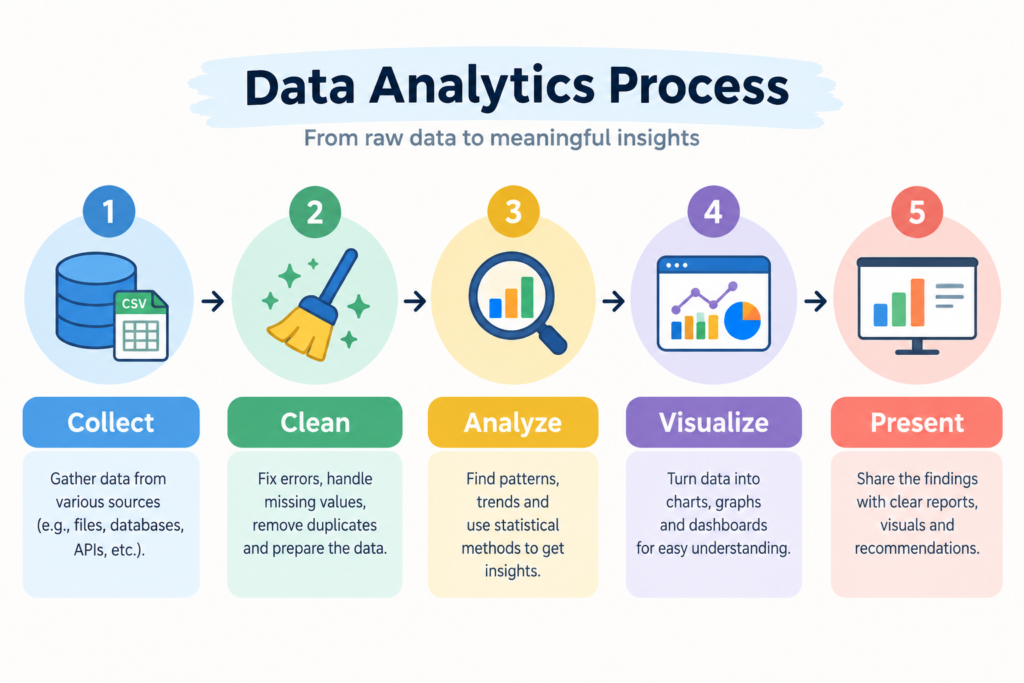
Before choosing a course, be clear about the job it prepares you for. A data analyst usually does the following:
- Collects data from spreadsheets, databases, forms or software systems.
- Cleans it, which means fixing duplicates, missing values and wrong entries. This is often the most time-consuming part.
- Analyses it to find patterns, trends and reasons behind them.
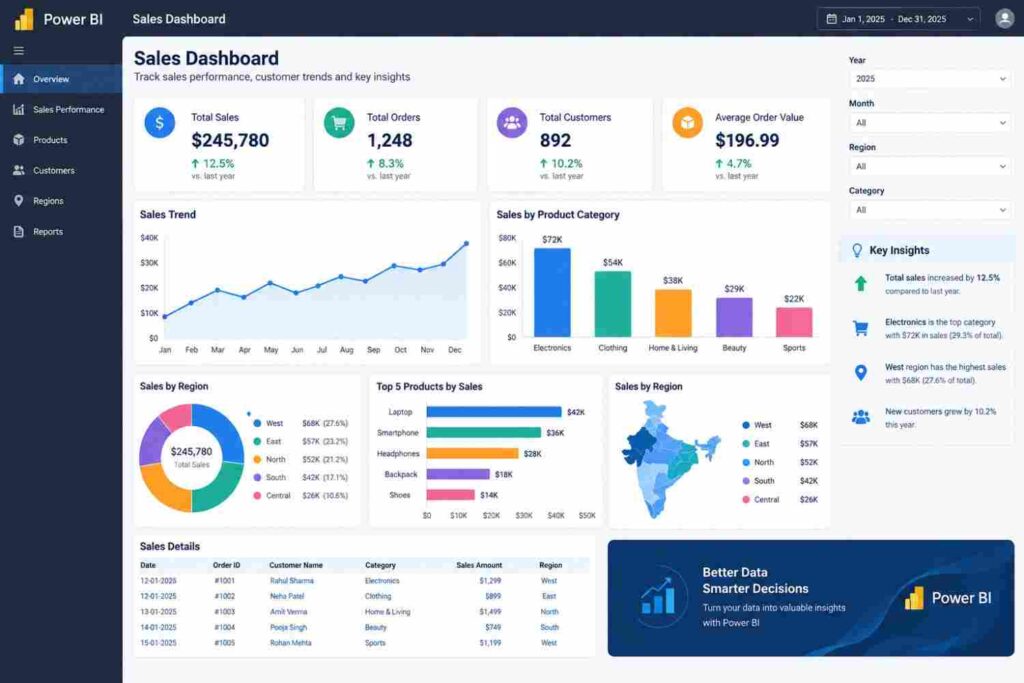
- Presents it through charts and dashboards that managers can understand in a few minutes.
- Recommends action, such as which product to push, which region is underperforming or which customers are likely to leave.
Notice that only a part of this is “technical”. Asking the right question and explaining the answer clearly matter just as much. A good course trains both sides.
Tip 1: Check That the Curriculum Covers the Core Skills
A strong data analytics course in Vadodara should cover a clear sequence of skills, not a random list of software. Here is what a well-built syllabus normally includes:
| Module | What you learn | Why it matters |
|---|---|---|
| Advanced Excel | Formulas, lookups, pivot tables, data cleaning, charts | Most companies still run daily reporting in Excel |
| SQL | Writing queries, joins, filters, grouping, subqueries | Data lives in databases, and SQL is how you reach it |
| Statistics basics | Averages, spread, correlation, probability, sampling | Helps you judge whether a pattern is real or a coincidence |
| Python for data | Pandas, NumPy, basic scripting | Handles larger datasets and repeated tasks |
| Data cleaning and exploration | Handling missing values, outliers, exploratory analysis | Real data is always messy |
| Power BI (or Tableau) | Dashboards, DAX basics, interactive reports | Turns analysis into something a manager can use |
| Data visualisation | Choosing the right chart, storytelling with data | A correct insight that nobody understands is useless |
| Real-world projects | End-to-end case studies | Proof that you can actually do the work |
| Career preparation | Resume, portfolio, mock interviews | Helps you convert skills into a job |
A quick test: ask the institute to show you the module-wise syllabus in writing. If the answer is vague or the brochure just says “Data Analytics with AI, ML, Big Data and Cloud” in a three-month course, be careful. Depth beats breadth, especially for beginners.
Tip 2: Look for a Beginner-Friendly Learning Path
Many people believe they need a maths or programming background to start. You do not. Plenty of successful analysts began as commerce graduates, BCA students, diploma holders or professionals from non-technical fields.
What you should look for is a gradual path:
- Start with Excel. It builds comfort with rows, columns and logic.
- Move to SQL. It teaches you how to ask a database a question.
- Add statistics. It gives you the thinking behind the numbers.
- Then learn Python and Power BI. By now the concepts are familiar, so the tools feel easier.
If a course jumps into Python in the first week without checking where you stand, a beginner will struggle. Ask if the batch has a foundation phase and whether doubts can be cleared in a separate session.
Tip 3: Insist on Hands-On Practice, Not Just Theory
Data analytics is a skill like swimming: you cannot learn it by watching someone else. When you visit an institute, ask these questions:
- How many hours of the course are practical lab time?
- Will I work on my own system with real datasets?
- Are assignments given after every module?
- Do I get feedback on my work, or only a “completed” tick?
A good rule of thumb is that at least half of your course time should be spent doing things yourself. Reading slides about pivot tables is very different from building one from 50,000 rows of sales data.
Example of a practical exercise: You are given a year of monthly sales for a retail chain with five branches in different parts of Vadodara, say Alkapuri, Manjalpur, Gotri, Akota and Karelibaug. Your task is to clean the data, find which branch grew fastest, spot the weakest months and build a one-page dashboard for the owner. This is the kind of work employers expect you to do on day one.
Tip 4: Evaluate the Projects You Will Build
Projects are what turn a certificate into a career. When employers see your portfolio, they are asking one question: can this person solve problems with data?
Look for a course that offers:
- Multiple projects, not just one at the end.
- Different domains, such as retail, banking, healthcare, HR or education, so you understand varied business problems.
- Complete workflow projects, covering cleaning, analysis, visualisation and a written summary of insights.
- Something you can show, such as a Power BI dashboard file, a SQL query set or a notebook you can share during interviews.
Ask to see sample projects from previous batches. If an institute hesitates to show student work, that tells you something.
Tip 5: Learn About the Trainers' Experience
A syllabus is only as good as the person teaching it. In data analytics, trainers with real industry exposure explain things differently. They tell you why a particular chart confuses clients, or what usually goes wrong with dirty data.
Questions to ask:
- What is the trainer’s background? Have they worked on live analytics tasks?
- How many students are in a batch? Smaller batches (roughly 10 to 20) allow more personal attention.
- Can I attend a demo class before enrolling?
A demo class is the single most useful step. In 45 minutes you will know whether the teaching style suits you: whether the pace is right, whether questions are welcomed and whether concepts are explained with examples or just read out.
Tip 6: Check Tool Relevance, Not Tool Count
Some institutes list ten or fifteen tools to look impressive. A fresher does not need all of them. The tools that matter most for entry-level roles are:
- Excel: universal and always asked in interviews.
- SQL: one of the most commonly listed requirements in analyst job descriptions.
- Power BI or Tableau: for dashboards.
- Python (Pandas): increasingly expected, especially for larger roles.
Everything else, such as advanced machine learning or cloud platforms, can come later once you have a job and know your direction. Learning four tools well is far better than touching fifteen superficially.
Tip 7: Understand Placement Support Honestly
Placement is a sensitive topic, so approach it with realistic eyes. No institute can guarantee a job, because hiring depends on your skills, communication and the market. Be cautious about promises of “100% placement” or fixed salary packages.
What genuine placement support looks like:
- Resume building tailored for analyst roles.
- Portfolio guidance so your projects are presented well.
- Mock interviews covering Excel, SQL and scenario questions.
- Interview preparation on common questions such as “How would you handle missing data?” or “Explain a join in simple words.”
- Job alerts and referrals through the institute’s network, where available.
Ask for specifics: which types of companies have previous students joined, and in what roles? A transparent answer is a good sign.
Tip 8: Compare Fees With Value, Not Just Price
Fee is naturally a big factor, but the cheapest course is rarely the best, and the most expensive is not automatically better. Instead of comparing only the number, compare what is included:
| Question | Why it matters |
|---|---|
| What is the total fee, and are there hidden charges? | Avoid surprises later |
| Is study material, lab access and software included? | Some places charge extra |
| What is the course duration and weekly schedule? | Check it fits your routine |
| Are EMI or instalment options available? | Useful for students |
| Are there weekend or evening batches? | Important for working professionals |
| Can I revisit a topic or repeat a class? | Shows how flexible support is |
Think of the fee as an investment. If a course costs a bit more but gives you real projects, mentoring and interview preparation, it may pay for itself faster than a cheap course that leaves you with only a certificate.
Tip 9: Pick an Institute With a Local Presence and Good Reputation
Learning close to home matters more than people expect. A local institute understands the Vadodara job market, can connect you with nearby companies and is easy to reach for doubt-clearing sessions. Vadodara has a mix of industries, including pharmaceuticals, engineering, chemicals, manufacturing, education and a growing IT and services sector, and all of them need people who can read data.
Before you decide:
- Visit the campus and see the labs and classrooms.
- Talk to former students if possible.
- Read genuine reviews on Google rather than relying only on the institute’s own marketing.
- Check how long the institute has been training students and how it handles feedback.
Established computer education centres such as Bright Computer Education in Vadodara focus on practical, job-oriented training, so students learn tools the way they are used in actual workplaces rather than memorising definitions. Whichever institute you consider, apply the same checklist and trust what you see in the demo class.
A Simple Step-by-Step Way to Make Your Decision
If you are feeling overwhelmed, follow this process:
- Define your goal. Do you want your first job, a career switch, or a skill upgrade for your current role?
- Shortlist 3 institutes offering a data analytics course in Vadodara.
- Collect the syllabus from each and compare it with the table in Tip 1.
- Attend a demo class at every shortlisted place.
- Ask about projects, batch size and support after the course ends.
- Compare total value, not just the fee.
- Decide and commit. Then plan your study hours before the first class.
Common Mistakes to Avoid
- Chasing trends. Do not pick a course only because “AI” is in the title. Fundamentals come first.
- Skipping the demo. A free trial class reveals more than any brochure.
- Ignoring your schedule. A course you cannot attend regularly will not help you.
- Believing guarantees. Be sceptical of job guarantees.
- Not practising outside class. Even the best course needs revision and self-practice, ideally an hour a day.
- Choosing without checking projects. Without a portfolio, interviews become harder
Who Can Join a Data Analytics Course?
The field is open to many backgrounds:
- Fresh graduates from commerce, science, BCA, BBA, engineering and other streams.
- Final-year students who want a skill edge before placements.
- Working professionals in accounts, sales, marketing, HR or operations who want to move into analysis.
- Business owners who want to understand their own numbers better.
- Career switchers from non-IT fields.
If you are comfortable with basic computer use and curious about numbers, you can begin. Consistency matters far more than your starting point.
Frequently Asked Questions
Look for a course that covers essential skills such as Excel, SQL, Python, Statistics, Power BI and Data Visualization. Also check whether it includes practical projects, experienced trainers, certification and career support.
Check the course syllabus, practical training, tools covered, project work, course duration, certification, trainer experience and career support before enrolling.
A good course should cover data cleaning, Excel, SQL, statistics, Python, data visualization, Power BI and practical data analysis projects. Advanced courses may also include AI tools and automation.
Important tools include Microsoft Excel, SQL, Python, Power BI and Tableau. Learning these tools can help you work with, analyze and visualize different types of data.
Yes. Beginners can start with basic concepts and gradually learn Excel, SQL, statistics, Python and visualization tools. A structured data analytics course for beginners should provide practical exercises along with theory.
The data analytics course fee varies depending on the institute, course duration, tools covered, projects, certification and training format. It is better to compare the complete course value rather than choosing a course only by price.
A recognized data analytics certification can help demonstrate that you have completed structured training. However, practical skills, projects and knowledge of analytics tools are also important when preparing for job opportunities.
Offline classes give you direct interaction and lab access, which many beginners find easier. Online suits those with tight schedules. Whichever you choose, make sure there is hands-on practice.
A good practical data analytics course should include projects using real or realistic datasets. Projects can help learners practice data cleaning, analysis, visualization, dashboard creation and reporting.
Important data analyst skills include Excel, SQL, statistics, data cleaning, data visualization, Power BI and basic Python. Communication, problem-solving and the ability to explain data insights are also valuable.
No. A certificate shows you attended. Your projects, problem-solving and communication in interviews decide the outcome.
Final Thoughts
Choosing a data analytics course in Vadodara is less about finding the “perfect” institute and more about finding the one that fits your goals, your pace and your learning style. Focus on a clear curriculum, hands-on practice, meaningful projects, experienced trainers and honest support. Take advantage of demo classes, ask direct questions and compare more than just the fee.
If you are exploring computer courses in Vadodara and want practical, career-focused training, you can speak to the team at Bright Computer Education to understand the course structure, batch timings and learning path before you decide. A short conversation and a demo class can save you months of confusion.
The best time to start building data skills was yesterday. The second best time is now. Pick your course carefully, practise regularly, build projects you are proud of and your first analyst role will be much closer than you think.
Call to action: Planning to start your data analytics journey? Visit Bright Computer Education to learn more about courses, batches and demo classes in Vadodara.